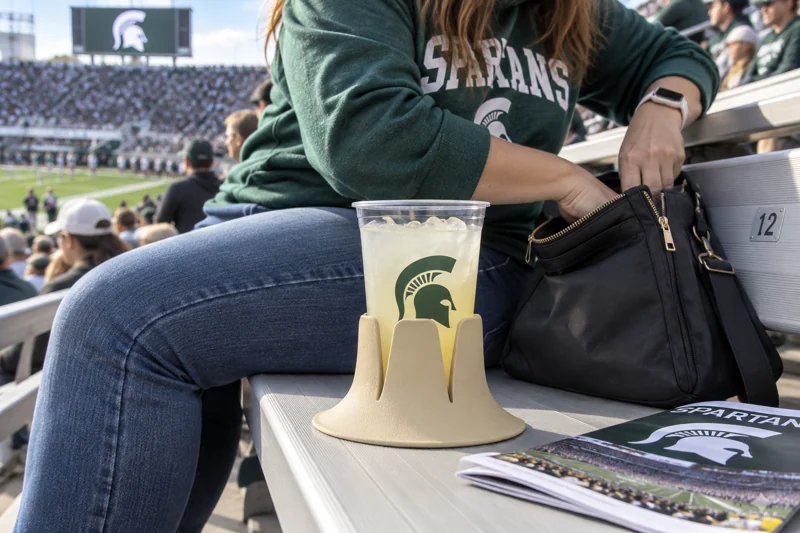
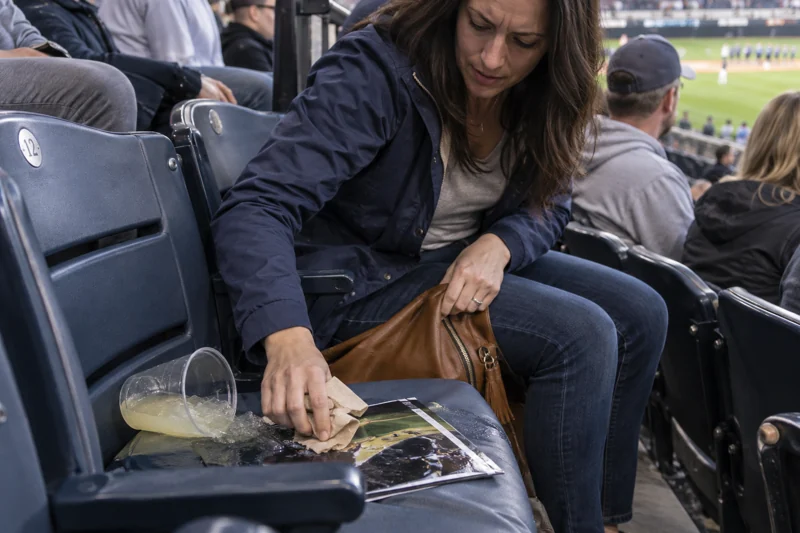
—A base for the deck at your seat
Whatever the designers intended, the ring works as a taper gauge, not a clamp. A 32 oz stadium cup is 2⅓″ at the base and 3⅞″ at the rim, so it drops in and wedges. That is the entire mechanism — no clamp, no spring, nothing that grips.
Straight-walled cups have no taper to catch. They ride high, or they sit on top. This is a 5.2″ base that goes on the deck instead, and holds by width.
4.9 average · 121 reviews
See the packsfrom $14.95 · free shipping on every order
Ships from Orange, California. 90 days to change your mind, used is fine.
—Read this before anything else
A bench has nothing to fasten a cup holder to and never will. Your seat is the opposite — a steel standard, a moulded back, an armrest, tamper-resistant hardware and a published spec sheet. Which makes the question sharper: why is the one you have the wrong size, and why do some rows have none at all?
Irwin Seating, one of the large American fixed-seating manufacturers, publishes the opening sizes of its rear-mount cup holders. There are five, and they are not the same.
3¼″ × 2¾″
rear-mount
The same fixed rear-mount fits Centura Mesh, Integra and Solara. The narrowest opening in the catalogue.
3⅜″ × 3¼″
rear-mount
An eighth of an inch wider than the Centura, and half an inch deeper.
3¾″ × 3″
rear-mount
The widest Irwin publishes. Millennium too. Half an inch of spread inside one maker’s own range.
$14.95
no ring required
A 5.2″ moulded base, 3.6 ounces, that the cup stands in. Tucked back under your own seat, where the ring never was.
Two things fall out of that. Half an inch of variation exists inside a single manufacturer’s catalogue, so “will my cup fit” has no general answer — it depends which chair your section was specified with, and that is not printed on your ticket. And no pocket in that list is deeper than three and a quarter inches, so whatever you set in it, the building is holding the bottom three inches or so and nothing else.
Source: irwinseating.com, published cupholder and chair specifications. Fetched 4 September 2026.
—The tell that this is real
Read that again, because it settles the argument. The cup that does not fit is not some oddball tumbler from home. It is the venue’s own cup, sold at the venue’s own stand, and it did not fit the venue’s own ring.
Fixing it took 60,000 cup holders, over 1,100 hours of production and 53,000 lbs of raw material to re-equip one stadium in one offseason. That is the cost of moving a plastic ring a fraction of an inch across a single NFL bowl.
The company still leads its current line on the same promise — a “larger opening” that “accommodates oversized and specialty souvenir cups.” Which tells you the problem is not solved everywhere. Your building has not necessarily had its turn.
Source: brandedseats.com case study and current product line. Fetched 4 September 2026.
—Does it actually work
It wobbles, then it settles. The base is 5.2 inches across and spreads the load instead of balancing the drink on its own bottom — which is the whole difference between this and the ring.
Filmed on a couch cushion — a soft, uneven surface, not a stadium riser. It is the honest test we have and we are not going to pretend it was shot in a ballpark.
—Why width beats taper
A tapered cup dropped into a 3¼″ ring descends until its expanding sidewall meets the plastic, and wedges. Snug, self-centring, no moving parts. Elegant — and it only works on a shape that widens as it rises.
A 32 oz stadium cup has a 3⅞″ rim over a 2⅓″ base. The Steadi puts 5.2 inches of footprint under that same cup, so the drink’s centre of mass has to travel much further sideways before it clears the edge of its own support. Tipping takes a far bigger tilt than it does on the cup’s own bottom.
—The object
Screening is the venue’s call on the day. A flat piece of TPU appears on none of the prohibited-items lists we read, but read yours.
—What seats and what does not
The 2⅓″ base of a 32 oz stadium cup sits comfortably in the range. So does a Stanley Quencher 40 oz at a published 3.1″. A YETI Rambler 30 oz is listed as 4″ × 7⅞″ × 2¾″ without saying which figure is the base, so we are not counting it as checked. A Quencher 30 oz at a published 3.15″ is at the very top of the range — worth checking your actual cup at the kitchen counter rather than guessing at the gate.
A handled mug does not seat at all: the handle lands exactly where the fins grip. Stemmed glasses do not seat either. Both are a straight no.
Every width below comes from a published specification, not from us. Where a spec is uncertain, the answer says so.
A width across the bottom of the cup, in inches.
A standard sticky note is three inches square. A cup standing on one with its base inside the paper will seat.
Anything that overhangs, or anything borderline — hello@steadilabs.com reaches a person, and the answer will be honest either way, including a no.
—Where it goes
That is the spot. The tread in front of your chair, pulled back under the seat pan so it is out of the walking line — or the countertop of a drink rail if your row fronts onto one.
Not in the middle of the row. The clear accessway your whole row sidesteps along is a code dimension, and anything set down in it is a projection into somebody’s path. Put it under your own seat and it is out of everyone’s way, including yours when you stand up for the seventh.
Twelve colours, one per unit — which is the fastest way to stop four people arguing about whose beer is whose in a dark upper deck.
—What the aisle costs
Prices and requirements were looked up on 4 September 2026, not estimated. Every figure in the last column is the seller’s own published requirement.
| The product | Price | What it asks of the seat |
|---|---|---|
| The ring already on the chair | Comes with the seat | A tapered cup with a base under about 3 inches, and a chair in front of you to mount it on. Openings run 3¼″ to 3¾″ depending which chair your section got. |
| Cup-holder armrest | Comes with the seat | That you and the stranger beside you agree whose it is. Chairs are measured centre-of-arm to centre-of-arm, so the arm straddles the line between two seats. |
| Clamp-on armrest cup holder | Varies | An armrest of a compatible width to clamp to. One listing states the requirement in its own title: compatibility with many tumblers, on an arm rest. |
| Drink rail | Comes with the building | A rail seat. SiteScapes Inc. lists stadium bar-height rails at 42″ with 10″ and 20″ countertop depths in “7 ga. stainless steel” (models UL6-72x10x42-SM and UL6-72x20x42-SM, read 4 September 2026). At a rail you have a table — solved problem. |
| The Stadium Seat Cup Holder | $14.95 · four for $39.95, $9.99 each | A flat surface under it. The deck at your feet is enough. |
Three honest concessions.
If your seat has a modern, correctly sized holder, use it. The current generation is marketed on a larger opening for oversize souvenir cups — that is the seller’s own description rather than an independent test, but nothing here beats a ring that fits. Club and premium seating is a different product — wider chairs, cup-holder arms, more row spacing. And drink rails work. At a rail you have a countertop and you do not need this.
The unsolved case is a specific ticket: a general-admission or upper-bowl seat in a bowl that has not been re-seated recently, holding a cup too wide at the base for the ring — or holding nothing at all, because your row has no chair in front of it.
Sources: irwinseating.com · brandedseats.com · bestbuy.com (YETI Rambler listing) · stanley1913.com · discountmugs.com. Prices and specifications fetched 4 September 2026 and current as of that date. Steadi Labs is not affiliated with any of them.
—Get one
Count the seats you actually buy together. For most people that is two or four. Free shipping on all of them.
Checkout is handled by Steadi Labs — the company that makes The Stadium Seat Cup Holder. Secure checkout at steadilabs.com. Free shipping on every order, and 90 days to change your mind, used is fine.
—From people who bought one
Verbatim, unedited, not filtered by rating. This is a slice of one product-wide corpus — reviews of the Steadi, not of this page. Nobody in it mentions a ballpark, and the four below are here because they describe the mechanism this page is claiming: a wide base on a surface that is not a table, and a drink that survives somebody standing up.

★★★★☆
The Steadi is everything you claimed. I place a tray on the couch cushion next to me with the Steadi, while watching TV. It’s so stable that it doesn’t budge when I get up and sit down. Is the Steadi dishwasher and/or microwave safe.
Customer · July 2026Photo from the buyerPhoto from the buyerPhoto from the buyerPhoto from the buyerPhoto from the buyerPhoto from the buyerPhoto from the buyer
★★★★★
Really does keep your drink cans and bottles from tipping over! We are quite impressed with these!
SPK · July 2026
★★★★★
Genius! Finally I can sit in a corner of the couch and have my drink next to me. Works beautifully, sturdy and stable. I’m very happy I found this item.
jlhinckley · July 2026
★★★★★
Steadi works very well in stabilizing my drinks on soft surfaces, like the couch or by the chair I use as a nightstand.
Marie Adams · July 2026
Sent in with their reviews. Tap any one to read it. Different rooms, different drinks, different colours — none of them staged by us.
The four-star is first on purpose. It is the one that describes getting up and sitting down without the drink moving, which is the closest thing in the corpus to a row of seats.
—Read this before you buy, including the part that costs us the sale
Sources: SoFi Stadium and MetLife Stadium published A–Z guest policies. Fetched 4 September 2026. Policies change; the venue’s own page is the authority on the day.
—Ninety days
Ninety days from delivery, used is fine. That is long enough for a homestand, or for one cold Sunday in the upper deck, which is the only test that matters. If the ring at your seat turns out to fit your cup after all, send it back.
—Who makes it
—Asked and answered
It is flexible, has no metal, is not a container and is not hard-sided, and it lies flat in a 12″×6″×12″ clear bag. It appears on none of the prohibited-items lists we read. But screening is the venue’s call on the day and we cannot promise you anything about it — check your building’s own policy page.
If it fits your cup, do. Nothing here beats a ring that fits. This is for the ring that was specified before your cup existed, or the seat that has no ring at all.
No. It needs a flat surface at least 5.2 inches across underneath it, so a narrow armrest top or a gap in decking will not do. The deck under your seat is the spot.
It can. Tucked back under your own seat pan it is out of the walking line, which is most of the answer — but a determined sneaker still wins, and we are not going to claim otherwise.
A 40 oz Quencher at a published 3.1″ base does. A 30 oz at a published 3.15″ is at the very top of the fin range — check it on a sticky note at home. And check the bag policy first, because a tumbler that size is over the limit at some venues.
Yes, top rack.
—Still deciding
The case study that started all this quotes the number itself: “When you spend $18 for a drink and branded souvenir cup, you would like it to fit in the cupholder.” This costs less than the cup did.
If your seat has a ring that fits, keep your money. If you sit at a rail, keep your money. If you are in the front row, or the upper deck of an older bowl, or you have watched a souvenir cup ride high on its own taper for two innings — that is what this is for.
Cup holders arrive with the chairs, replacing them across a bowl is a 60,000-unit offseason project, and the code has already allocated the inches between your knees and the row ahead to people walking past. That is not changing this season. You just do not have to keep setting the cup on the step.
See the packsfrom $14.95 — free shipping on every order
90-day guarantee, used is fine · Made in Orange, California